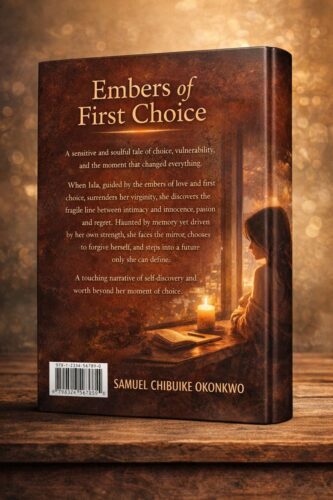
A narrated coming‑of‑age story
Chapter One: Before the Flame
Listen gently, dear reader, for this is not a tale of shock but of truth; not of scandal but of becoming. It is the story of a young woman who stood at the quiet border between who she had been and who she would choose to be.
Her name was Amara, and she was twenty‑one years old—old enough to carry her own keys, old enough to know the weight of decisions, old enough to learn that innocence does not vanish in a single night. It only changes its clothes.
Amara grew up in a house where values were spoken carefully, like china brought out only on special days. Her mother believed in patience. Her father believed in discipline. Love, in that house, was steady and respectful, but rarely discussed in words that reached the heart’s hidden rooms.
From an early age, Amara learned to be careful.
Careful with her dreams. Careful with her emotions. Careful with her body.
She was praised for her restraint, admired for her focus, trusted for her boundaries. Friends called her “the good one,” as if goodness were a box she had promised never to open.
Yet inside her lived questions—quiet, glowing questions that waited like embers under ash.
What does it mean to choose for yourself? What does it mean to give, not because you are pressured, but because you are ready?
Amara carried these questions with her into adulthood, into university halls and late‑night libraries, into friendships that buzzed with laughter and whispered confessions.
And then she met Ethan.
Chapter Two: The Warmth of Nearness
Ethan did not arrive like a storm. He arrived like warmth.
He listened more than he spoke. He noticed the pauses between Amara’s sentences, the way she tucked her hair behind her ear when thinking, the care with which she chose words. He did not rush her; he did not chase. He stayed.
Their conversations began innocently—books, music, future plans—but slowly, gently, they widened. They spoke of fear. Of expectations. Of the quiet pressure placed on young adults to be perfect while still discovering themselves.
With Ethan, Amara did not feel watched. She felt seen.
Their closeness grew not from urgency, but from trust. Hands brushed. Smiles lingered. Silence became comfortable.
Still, Amara guarded herself. She knew what people said. She knew the stories told in sharp voices and softer warnings. She knew how quickly a woman’s worth could be measured by choices made in private moments.
Yet she also knew something else: her body was not a rumor. It was her own.
And choice, she was learning, is not recklessness when it is honest.
Chapter Three: The Night of Decision
The night did not arrive loudly.
There was no dramatic music, no reckless rush. Only a quiet evening, shared laughter, and a long conversation that drifted into truth.
Amara spoke first.
She spoke of her fears—of disappointment, of judgment, of crossing a line she could not uncross.
Ethan did not interrupt. He did not persuade. He did not promise anything he could not keep.
He said only this: “Whatever you choose should feel like your own voice, not an echo of someone else’s.”
In that moment, Amara understood something important.
Virginity, she realized, was not a fragile object that shattered. It was a chapter—one that could be closed with care or torn out in fear.
When she chose, she did so consciously, calmly, and without shame.
There was tenderness. There was nervousness. There was vulnerability. There was learning.
But above all, there was consent, respect, and presence.
When the night passed, Amara did not feel lost.
She felt awake.
Chapter Four: Morning Light and Heavy Thoughts
Morning arrived with questions.
Not regret—but reflection.
Amara walked alone later that day, letting the world continue as if nothing had changed. People laughed. Cars passed. Life went on.
Inside her, however, something had shifted.
She wondered how the world would see her if it knew. She wondered whether she was now less—or simply more aware.
The answers did not come immediately.
But slowly, as days turned into weeks, Amara noticed something unexpected: she had not lost herself.
She had gained clarity.
She became more honest in her relationships. Firmer in her boundaries. Kinder to her own mistakes. Less willing to live by borrowed expectations.
What she had given was not her worth.
What she had gained was ownership.
Chapter Five: The Flame That Stayed
Years later, Amara would look back on that season not as a fall, but as a crossing.
She would understand that womanhood is not defined by what is kept or given, but by how one lives afterward.
Her strength did not disappear.
It matured.
She learned to speak openly. To guide younger women without fear. To tell them this truth:
You are not ruined by choice. You are not pure by silence. You are powerful when you decide with wisdom and self‑respect.
Amara carried her story not as a secret, but as a torch—lit not by shame, but by understanding.
And wherever she walked, she walked whole.
Because the night did not take her light.
It revealed it.
The End